The red flour beetle is one of the most common but most underestimated pests in flour mills, warehouses, grocery stores and home kitchens. It doesn’t bite; it can’t carry diseases like mosquitoes and rodents, and a few can be ignored for weeks, but when you discover it, it is mostly infested and found in many bags and bins of stored products. Understanding effective red flour beetle control methods is therefore essential to stop the infestation from spreading and protect stored food products.
Infestation begins in flour, grains, cereals, pasta, spices, and other dry-stored foods, particularly when food has been left in long-term storage in warm, humid environments. The red flour beetle is found. Preventing an entire shipment or storeroom from being contaminated is the difference between a quick clean-up and a costly product loss and depends on catching an infestation early.
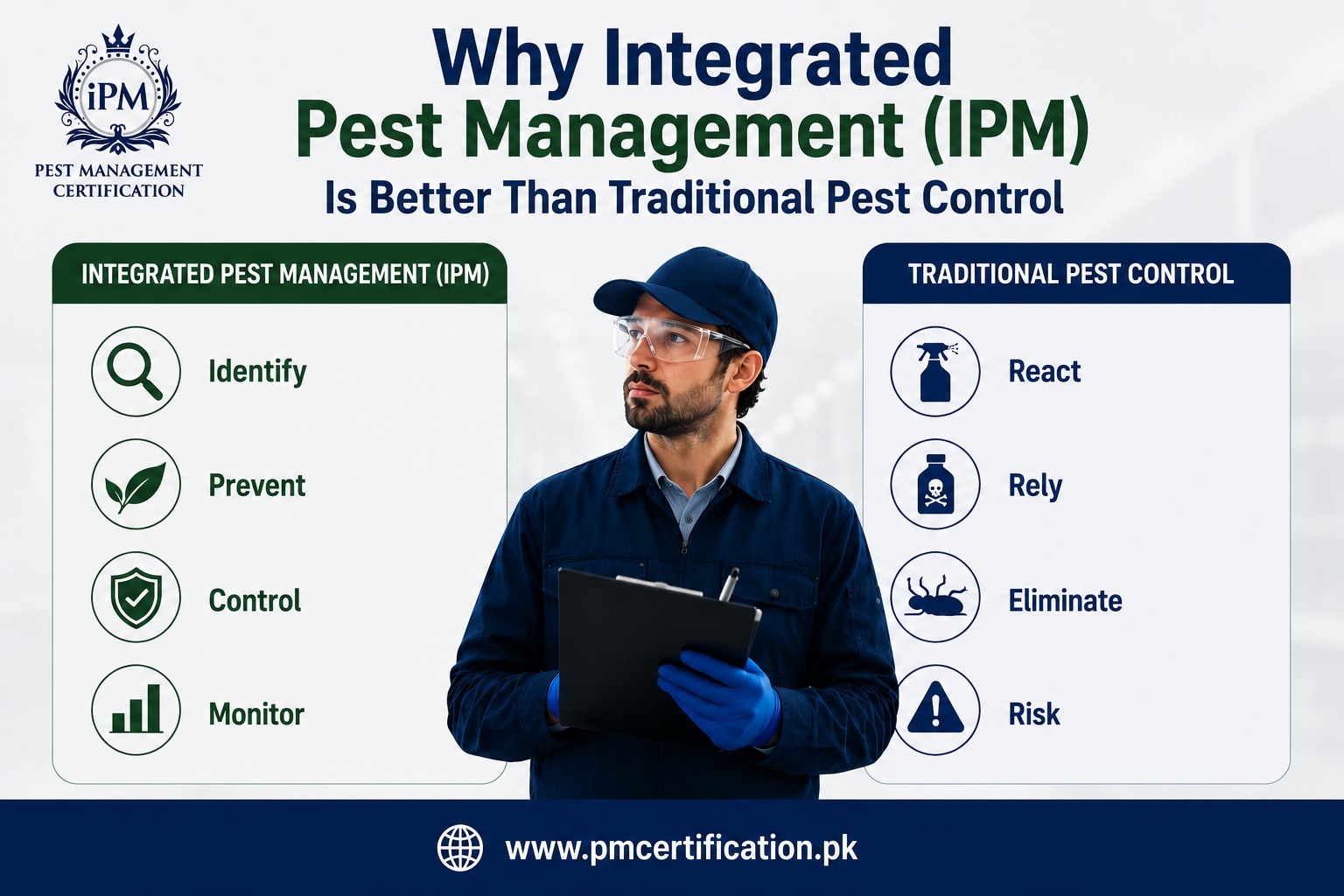
This is where Integrated Pest Management (IPM) becomes valuable. IPM is a holistic process of inspection, sanitation, monitoring, prevention, and control that does not involve the use of an insecticide as the first step when beetles are detected. We’ll explore the biology of the red flour beetle, how to quickly detect a problem, and how to effectively manage red flour beetles in accordance with the best IPM practices. You will also explore how IPMC certification programs help you understand the red flour beetle from prevention to identification, management, and control methods using IPM principles
What Is the Red Flour Beetle?
Tribolium castaneum is a small, reddish-brown beetle of the darkling beetle family (Tenebrionidae). It is regarded as one of the most economically destructive pests of stored cereal products throughout the world and is a pest of flour mills, grain stores, food processing plants, and retail stores of food.
The beetle is a frequent infester of food items that are most commonly stored in flour, milled grains, cereals, pasta, biscuits, spices, dried fruits and nuts, but it will infest any dry, starchy, or processed food product that is stored for a length of time. It is a secondary pest of grain; it will not bore into whole, sound grain like some primary pests.
However, the confused flour beetle (Tribolium confusum) is often confused with the red flour beetle. First, the two resemble each other exactly to the naked eye and second, their larvae are almost impossible to distinguish. Proper identification is important because it determines the way a pest infestation is monitored and controlled; that is why a trained pest management professional is trained to take a close look before he or she recommends a plan for control.
How to Identify a Red Flour Beetle?
Adult red flour beetles are small, flattened, reddish-brown to rusty-colored beetles about 3-4 mm long. Some features that help you to identify:
- Antennae: End in a distinct 3-segmented club (clearly different from the confused flour beetle with less clearly defined antennal club).
- Body shape: Flat and oval; the beetle has a small body that can move easily inside cracks, seams and gaps in packaging.
- Surface texture: Fine punctures on head and upper thorax when magnified.
- Larvae: Slender, cylindrical, yellowish-white, bristled and pale brown-headed. Larvae are active and will often infest flour or grain dust.
- Adults vs. larvae: Larvae stay in food and feed continuously as they grow, whereas adults are hard-shelled and capable of infesting new food storage locations and are mobile.
The adults of the red flour beetle and confused flour beetle are very similar in appearance and need careful examination in the field with a magnifying glass to get the right ID.
Red Flour Beetle Life Cycle and Behaviour
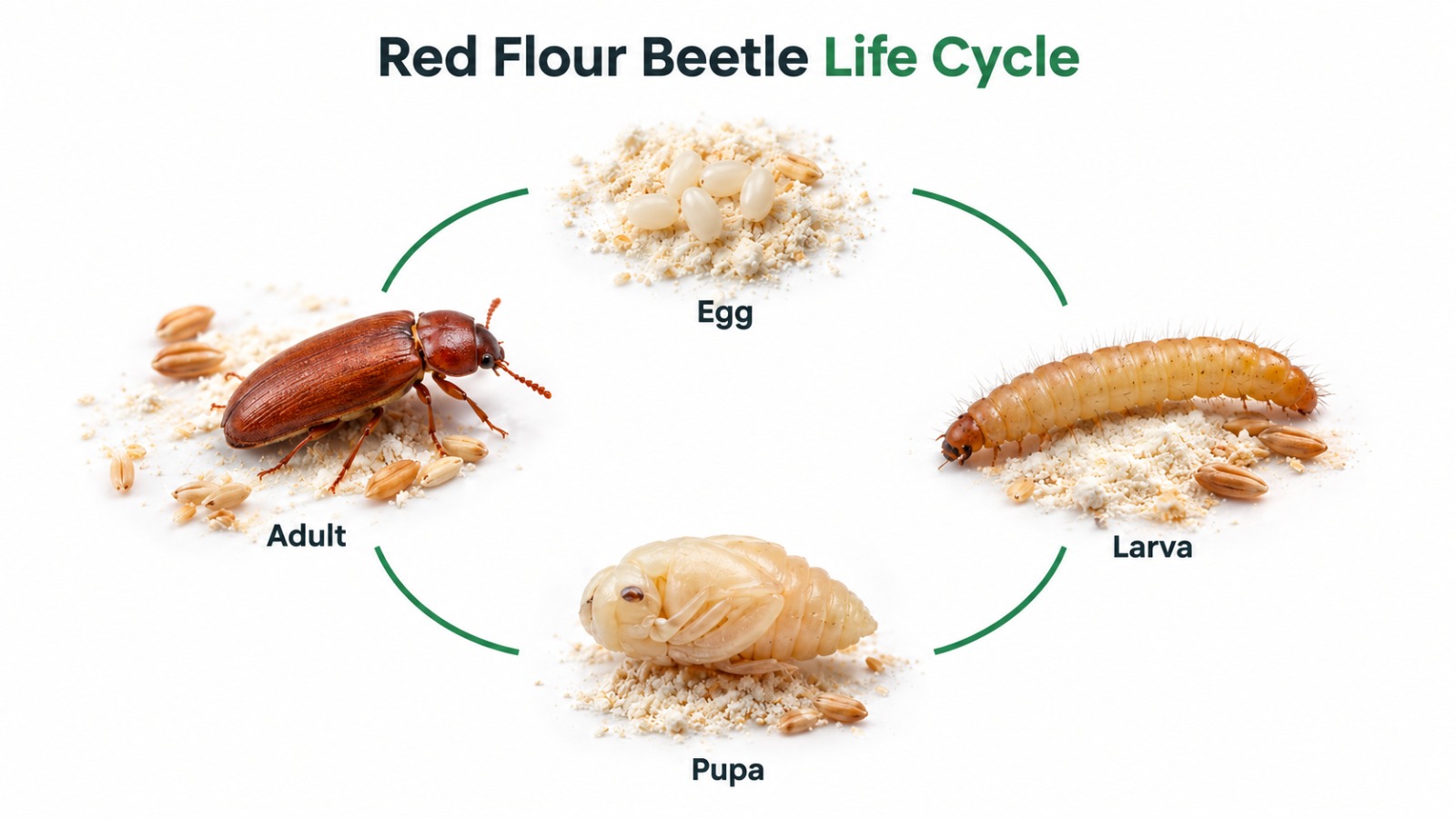
The red flour beetle has a complete metamorphosis, consisting of four stages: egg, larva, pupa and adult.
- Larvae go through several moults as they feed and grow, which can occur in a few weeks in warm temperatures and be extended over many weeks in cool storage. When mature, larvae pupate, and the resulting adults emerge within 1-2 weeks.
- The speed of this cycle is greatly influenced by temperature and humidity. Development time is reduced, and reproductive rates increase in warm, moist conditions (poorly ventilated storage areas or in summer), bringing infestations up sharply.
- Larvae and adults gnaw at flour, grain dust and broken kernels continually. Adults also fly and can move from a storage location or product to another.
It is crucial to know this life cycle to implement IPM effectively. Timing of inspection, monitoring and treatment should be synchronized with each developmental stage to avoid establishment and proliferation of additional generations. Red flour beetles have been found in many locations, most commonly with wheat, rice, flour, and whole grain products.
Where Red Flour Beetles Are Commonly Found?
Red flour beetles are found virtually wherever dry food products are stored for long periods, such as:
- Flourmills/grain processing facilities
- Commercial bakeries and food manufacturing plants
- In stored wheat, red flour beetles are found because of moisture, broken kernels, and the grain dust.
- Restaurants and commercial kitchens with dry-goods storage
- Residential pantries, particularly when unused for extended periods of time, where flour, cereal or grains are stored.
They are, in particular, persistent in facilities where the product spills into cracks, corners and into the seam of equipment, which leave a constant food source even after the visible packaging has been cleaned.
Signs of a Red Flour Beetle Infestation
Red flour beetle infestations are often discovered indirectly, as the beetles are small and often found inside the product.
- Reddish brown beetles crawling on or near stored food packages
- Fine and powdery flour or grain products or clumping in flour and grain products
- A sharp, pungent smell from stored products from the secretions of the beetle’s scent glands.
- When flour turns grey or discoloured from being white, it happens due to moisture, dust and broken kernels, especially in wheat and rice
- Larvae have caused minor movement; the product appears to be moving slightly
- Beetles near cracks, shelving, storage bins or equipment seams in the vicinity of food storage areas.
These early signs can be identified most easily during routine inspections, before a problem is readily discerned by the naked eye and is typically much more extensive than an infestation within one container.
How Do Red Flour Beetles Damage Stored Products?
Red flour beetle damage is more a problem of contamination than destruction. Beetles and larvae cast their skins, shed dead bodies, excrete and defecate while they feed and move within flour, grain and other dry products, contaminating the product directly.
This contamination impacts the quality of food much beyond what is consumed. Flour can be heavily infested yet show no visible signs of infestation because the infested flour can clump, take on a greyish colour, and develop an undesirable odour from the beetle’s scent gland secretions. This can negatively impact your customers and also lead to stock returns.
Infestations are not likely to be isolated to a single bag or bin. Adult beetles fly and crawl easily between packages, and a small opening is sufficient for them to transfer beetles from one product to another in another container in the area; if not detected early, they can cause contamination of an entire storage area.
That’s why prevention is especially important in commercial food-storage settings. One unnoticed infestation in a warehouse or mill can lead to food-safety inspection failures, product recalls, and the ruin of entire batches of product, but regular monitoring and sanitation control the red flour beetle to prevent infestation.
Integrated Pest Management for Red Flour Beetles
To achieve effective, prolonged control of red flour beetles, a structured IPM approach must be followed, not a single spray treatment. Let’s look at this step-by-step.
Step 1: How to Prevent Red Flour Beetle Infestations
The key to a successful red flour beetle control program is prevention, which begins before the beetles even invade:
- Before handling or storing incoming food products, inspect for signs of damage.
- Store in proper, tightly closed containers, not bags.
- Keep good general sanitation during storage and processing areas.
- Do not store old or slow-moving materials for a longer period than needed.
- Swap items in and out according to first in, first out (FIFO).
- Vigorously check the storage areas, shelving and equipment for signs of activity regularly.
- Block beetle hiding places and movement between containers by sealing cracks, gaps and seams.
- Create a schedule of monitoring rather than ad hoc approaches.
Step 2: Inspect the Infestation and Identify
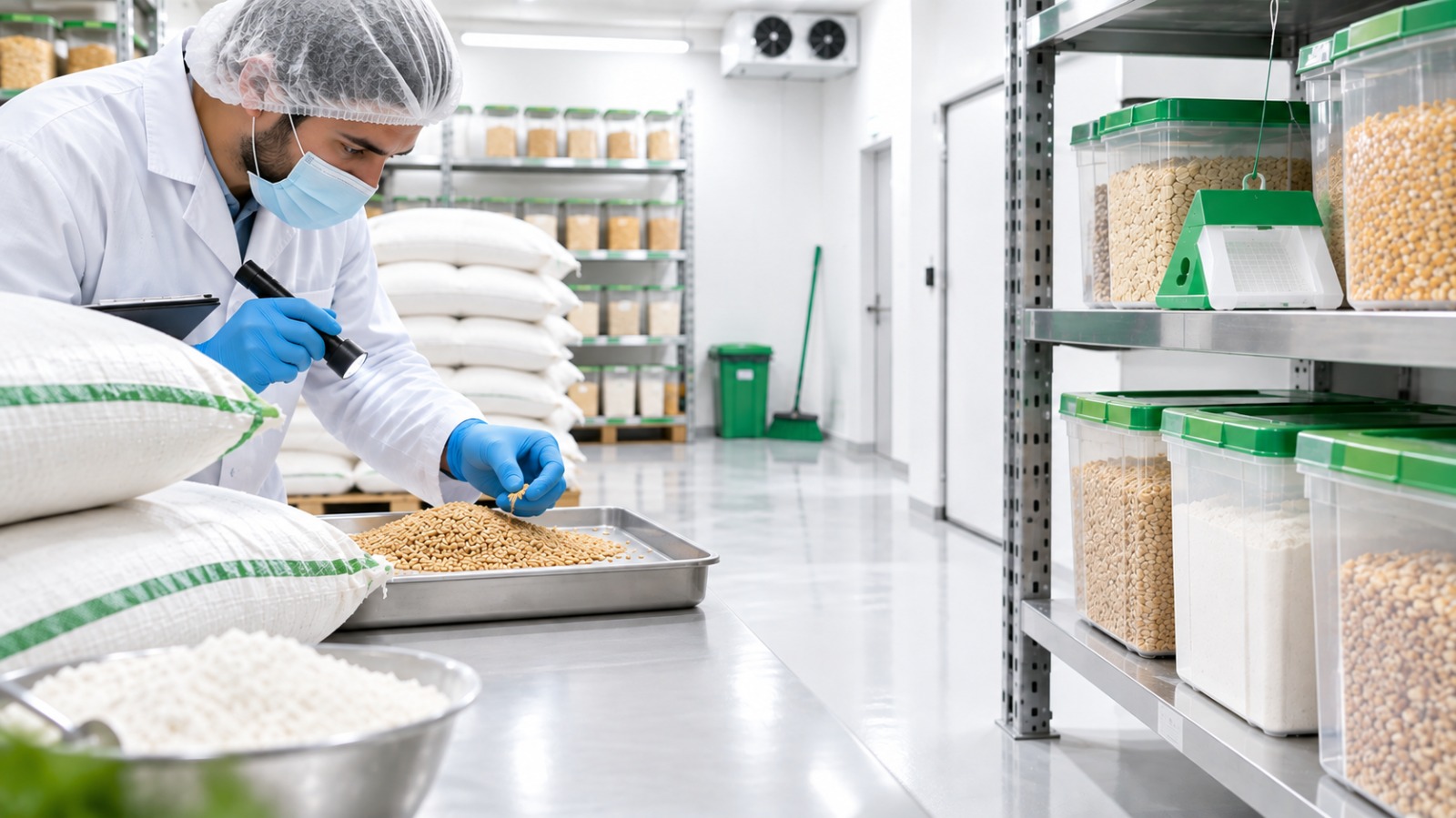
If any activity is detected, it is important to conduct a comprehensive inspection but not immediate treatment. This involves inspecting food packages, shelving, cracks, storage equipment, etc., and nearby food containers to determine the extent of the problem.
It is important to be able to identify the correct one here. Knowing for certain that the pest is the red flour beetle and not a similar species, such as the confused flour beetle, can mean that correct control measures and monitoring methods are applied instead of a guess.
Clean and dispose of infested food.
Step 3: Improve Sanitation and Remove Infested Food
For red flour beetles, sanitation is a key component of IPM and is often the most effective non-chemical control measure:
- Remove spills of flour, grain dust, and food debris, which are a constant food source, even after packaging is cleaned.
- Clean the cracks, corners, shelving, and other hard-to-reach places where residue and beetles collect.
- Remove and dispose of contaminated products in enclosed containers to avoid the spread of beetles.
If this is not performed, the food source and hiding places will not be addressed by chemical or physical treatments and only temporary relief will be achieved.
Step 4: Use Monitoring Methods
Continuous monitoring provides you with information about the extent of infestation after treatment – whether it is increasing, staying steady, or decreasing:
- Visually inspect storage areas and products regularly.
- Consider using pheromone monitoring traps like Torios Multi in facilities (where appropriate) to identify activity before it is seen.
- Make a routine inspection program instead of waiting for complaints.
- Continuously monitor track performance and assess the effectiveness of track actions or other adjustments that may be necessary.
Step 5: Improve Food Storage and Exclusion
Longer-term prevention depends on how products are kept day-to-day:
- Keeping beetle-infested goods (flour, grains, cereals) in pest-proof containers is necessary.
- Keep storage areas clean, tidy, and uncluttered.
- Don’t overstock so that the merchandise cannot be sold in a safe period.
- Seal cracks and possible hiding areas regularly as part of running the facility.
- Practices regular stock rotation to avoid products being stored for sufficient time to attract pests.
Step 6: Consider Physical and Environmental Controls
Environmental factors can facilitate sanitation and monitoring where feasible. Red flour beetles reproduce and develop more quickly when stored at elevated temperatures and humidities; reducing these will slow development and reproduction. For some facilities, cold storage or controlled-atmosphere storage may be considered; but for others, more attention may be given to ventilation and moisture control.
Depending on the type of facility and the stored product in question, the physical or environmental controls that will be effective will vary; it is not possible to apply the same control to a home pantry that can be applied to a commercial grain silo or flour mill.
Step 7: Use Chemical Control Only When Necessary
In this step, you will explore how IPM for stored product pests can help you avoid unnecessary chemical control. Insecticides should only be used after inspection and sanitation, but they only address surface pests. Underground larvae or hidden eggs require professional inspection that not only monitors the pest but also identifies the initial cause of the infestation. Fumigation is usually considered the most effective treatment for heavier or more widespread infestations of beetles and larvae in stored products, such as grain silos, mills, or large warehouses, where surface treatments could not reach the larvae and beetles. Common Mistakes to Avoid When Controlling Red Flour Beetles
These are some common pitfalls to avoid when trying to treat a condition:
- Untreated eggs, larvae, and hidden beetles: Only treating visible beetles and not the eggs and larvae or the hidden beetles.
- Failure to monitor nearby stock: Failure to monitor stock that may be located near the infestation and already contaminated.
- Improper disposal: Not removing or properly disposing of contaminated foods or items.
- Excessive insecticide use: chemical control without sanitation or storage or exclusion.
- Failure to follow up monitoring: Not doing post-treatment monitoring; not realizing that a resurgence has taken place until it is seen again.
- Misidentification: Using the wrong control method due to incorrect identification.
One of the major reasons for these errors is the lack of a proper Integrated Pest Management (IPM) protocol, which involves inspection, sanitation, monitoring, prevention and targeted treatment. To enhance your pest control skills and become a pest professional, you need to choose programmes such as the CTP Program, Certified IPM Entomologist (CIE) and Certified Associate Entomologist (CAE). These programmes help you meet pest control challenges, such as the red flour beetle, and support your growth in the pest control industry by opening multiple opportunities.
Frequently Asked Questions
Are red flour beetles harmful to humans?
Red flour beetles are harmless to human beings as they do not bite, sting or spread disease. They secrete, shed skins, and produce excrement; however, this contaminates food, potentially altering its taste, smell, and quality, and in extreme cases may cause allergic reactions in susceptible people.
What foods do red flour beetles infest?
Red flour beetles primarily infest flour, rice, cereals, cake mixes, and other dry, starchy processed foods. They require complete treatment because eggs can remain hidden, hatch, or be missed, leading to adult infestation.
How do red flour beetles get into stored products?
Usually, these beetles move in through damaged packaging, from residues in storage areas, or by flying or crawling in from nearby infested products. They can get between food sources easily through cracks, gaps and unsealed containers.
How can you get rid of red flour beetles?
Good control involves correct identification, removing infested products, sanitation, sealed storage, regular monitoring using pheromone traps, and, if necessary, chemical treatment (e.g., fumigation) as part of an overall IPM program, not as a single panacea.
Can red flour beetles return after treatment?
Yes, they return if left untreated. Eggs can remain unhatched and survive, leading to a new infestation, so continuous monitoring is essential to detect any resurgence.
Conclusion
Red flour beetles rarely begin to infest large quantities of flour; a few eggs can go unnoticed in a bag of flour or crack behind a storage shelf. The reason effective red flour beetle control measures are effective is that they attempt to solve the problem at its source rather than the beetles that are present at the time of the inspection. All IPM plans rely on identification, inspection, sanitation, storage/exclusion, and monitoring, and chemical applications such as fumigation should be considered only when they are truly needed. The best way to prevent re-infestation and to detect the next infestation in time is to keep storage areas clean, dry, well-sealed, and regularly inspected.
Desire to professionally develop the skills needed to create and manage stored-product pest programs similar to this? Learn about IPMC’s certifications and start on the path to becoming a qualified pest management professional.