The importance of pest management certification to the pest management industry lies in that it creates a sense of credibility, professionalism, and competency. It guarantees that pest management experts have completed the requisite training and are aware of appropriate safety measures by keeping their minds concentrated on appropriate industry practices. Certification of pest management experts enables them to guarantee public safety and safeguard property from probable destruction. By using certification, individuals can convey their expertise in the application of Integrated Pest Management (IPM) and regulations regarding proper application of chemicals. Pest management certification experts can generate trust from their clients and eventually help them advance their professional work by adopting responsible measures.
Importance of Certification
A fundamental component of a credible pest management sector is the certification of a professional in the field. It proves that the person has undertaken training in the respective field, completed the training sessions with efficacy, and possesses a lucid knowledge base regarding standards and regulations set in the specific profession, including IPM Training. Such a situation is more significant in an industry that directly influences public health, food hygiene, and environmental protection. With a certification in pest control specialists, the practices would be more capable and efficient in applying safer and more effective techniques with minimal risks to the environment and the people they work with.
Enhancing Safety and Compliance
One important reason why certification is significant is the issue of safety. Pest management technicians handle chemicals, machines, and dangerous workplaces, for instance. Harmful application of pesticides without proper IPM training could result in health problems, environmental degradation, and legal consequences. Certified professionals are trained in:
- Appropriate choice and dosage of pesticides
- Proper management, containment, and disposal of chemicals.
- Utilization of personal protective equipment
- Urgent action and initial care methods
Building Trust with Clients
Homeowners, businessmen, and institutions require assurance that they are hiring competent and responsible professionals. A certification is a token of the qualification and responsibility. Certified pest management professionals tend to win client confidence because they:
- Follow standardized procedures
- Apply treatments responsibly
- Provide accurate pest identification and solutions
- Maintain Transparent Documentation
Role of IPM training
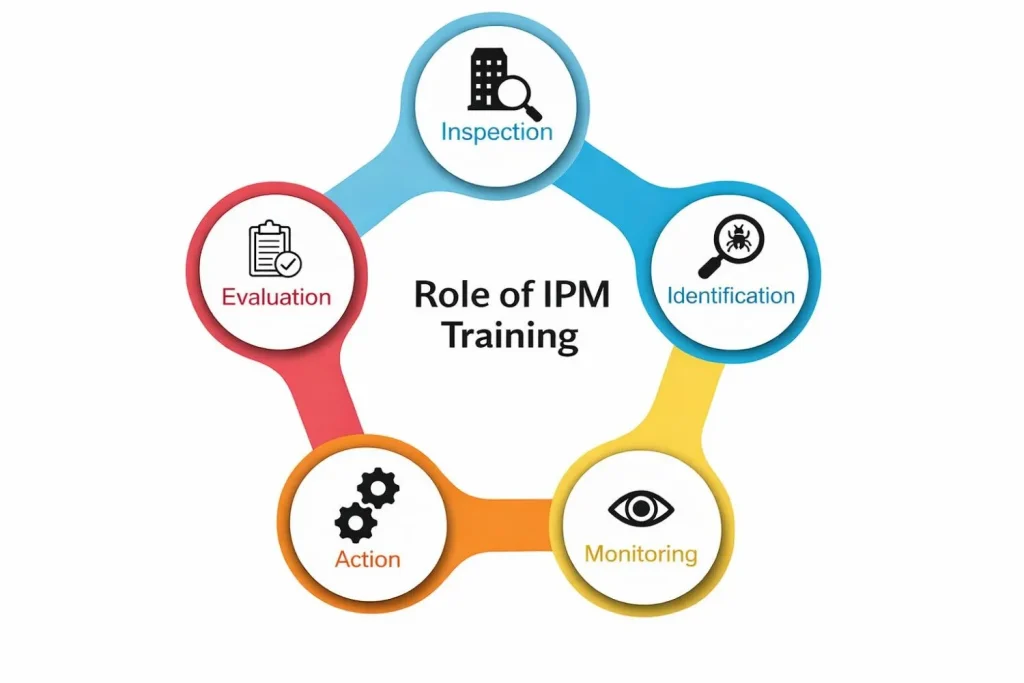
Integrated pest management is considered the pillar upon which modern pest management techniques are built. It ensures that there is a systematic approach towards the combination of inspection, monitoring, identification, and prevention in order to achieve control. Integrated pest management, aside from chemical control, also includes other methods like sanitation, altering the habitat of pests, as well as mechanical control. This way, the risk of impairing human health, properties, and the ecosystem, is reduced. Certification programs are placing greater importance on IPM training to guarantee that professionals are aware of responsible and compliant practices.
Understanding IPM Principles
IPM training helps technicians learn how to manage pest problems with a variety of methods, not just chemical methods. Certified pest control specialists le arn to:
- Identify pests life cycles
- Monitor pest activity using traps and inspections
- Set action thresholds before applying treatments
- Use different IPM tactics like cultural, mechanical, biological, and chemical control correctly.
- This method results in more effective and sustainable pest management outcomes.
Reducing Chemical Dependency
One of the main advantages of IPM training is to minimize reliance on chemicals. Certified technicians understand when pesticide application is necessary, and when other control measures are more effective. Firstly, they learn:
- Reduce health problems among professionals
- Prevent chemical resistance in pests
- Protect beneficial species and ecosystems
In critical sectors like schools, hospitals, or food-processing facilities, IPM-trained and certified professionals play a multifaceted role.
Urban Pest Management Needs
Pest behavior has also been influenced to a great degree by urbanization. In this regard, urban pest management in urban cities is complex compared to the past. These pests have an ample supply of food, housing, and breeding grounds as a result of the huge population density, inadequate waste management, increased developmental activities, and old buildings. Inconveniences in the climate also allow these pests time to prolong their mating season and quickly adapt to the urban environment, which results in problems for them.
Therefore, it would be very crucial in this case for these pest control experts to be accredited, especially in urban cities. Naturally, this would aid in their training sufficiently to comprehend the ecology of urban pests, detect infestations, and implement focused management methods all of which are typically based on research. Certified pest control specialists are also aware of other crucial methods, especially in urban areas.
Complexity of Urban Environments
Pest control in an urban area includes dealing with a number of pests. It includes pests like rats, cockroaches, mosquitoes, termites, bed bugs, and others that are usually considered as stored product pests.
- Assess complex building structures
- Identify pest entry points and harborage areas
- Design customized treatment plans for apartments, offices, malls, and public spaces
Without certification, technicians may also apply inappropriate methods of treatment, which provide temporary solutions but actually do not cure infestations.
Public Health Considerations
Urban pests are a significant danger to health because they lead to allergies, spread diseases, and spoil our foods. It is, therefore, a must to have an expert who is conversant and familiar with pests and the health risks that a populated area presents. A pest control expert who is authorized to do pest control work is trained to apply safe and controlled measures that minimize risks to people and the environment. A pest control specialist who is trained in the art of IPM focuses on precise treatments. By assuring that pest management practices are in compliance with national and international guidelines on environmental safety and health laws, a pest control business helps create a secure and healthy city living and working environment.
Community and Environmental Responsibility
Moreover, urban pest management is not just about pest destruction; it is about the protection of the community and the environment. Pest control experts are not only meant to destroy insects; they are meant to handle the community as well as the locals, encouraging preventative approaches such as ensuring the buildings and community are as clean as possible to ensure effective management of pests.
Career Growth in Pest Control
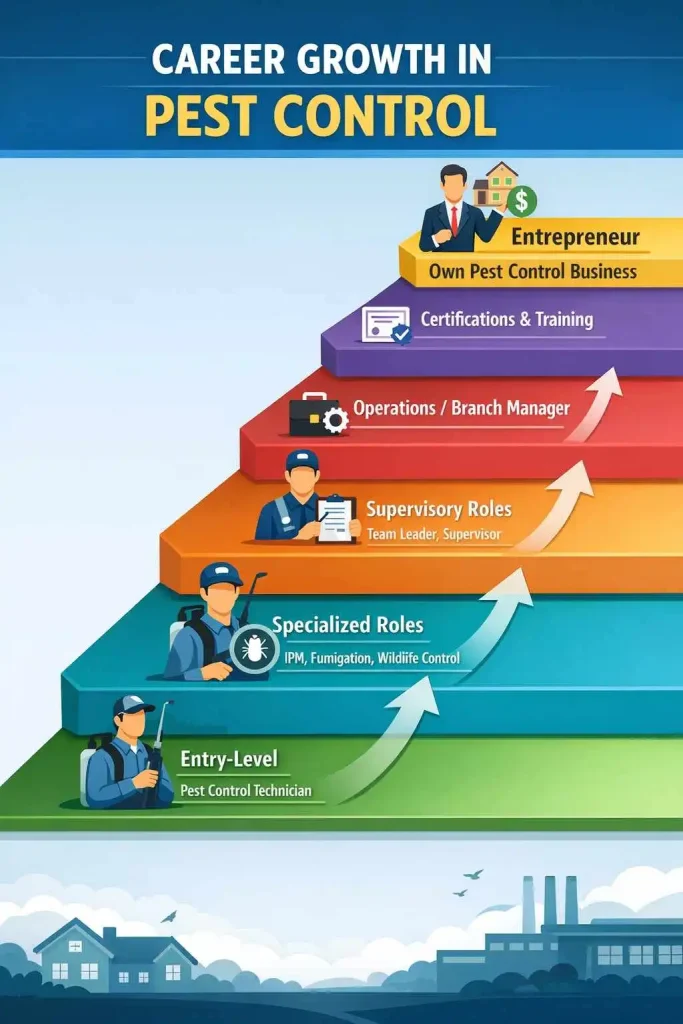
In the pest management sector, certification is a powerful tool for career advancement and development. Employers and customers prefer to hire certified and qualified experts with the growing regulations and competition. A certification provides people with a competitive advantage in the job market. They can prove their technical knowledge, skills, and commitment to the required standards in their respective fields. A trained and certified pest control worker can deal with a complex case in an effective manner.
Trained professionals in the field develop a better understanding of prevention-oriented techniques that minimize drug dependency and improve control outcome levels. At the same time, professionals receive better-paying jobs, management positions, and professional roles in urban and commercial settings. This means that through the IPM training, the pest control specialists gain confidence and credibility in the chosen profession of the individual. It eventually translates to the ability to gain the trust of the people in large, the government, and even organizations while using effective ethical and sustainable means of controlling pest infestation.
Frequently Asked Questions (FAQs)
An expert who has successfully completed the specified training for IPM certification and demonstrated that he knows the safety standards, law, best practices, and techniques for dealing with pests is seen to have attained the qualification for pest management. It will make one successful and efficient in the provision of the service.
Pest management certification is very important in the industry. It shows professionalism, and even trust. As the services of pest control are on the rise in urban, commercial, and residential areas. The liabilities associated with pest management technicians are on the rise as well.
There is an increased risk to public health and a necessity for supervising regulation. Accreditation is a necessity or strongly recommended with reference to urban pest management. In complex urban settings like flats, workplaces, health care facilities, and food businesses, certified employees are best suited to manage pests.
Yes, IPM Certification provide career growth by enhancing job opportunities. It improves earning potential and opens pathways to supervisory or management roles. Employers usually prefer certified professionals, and clients have more trust in their abilities.
IPM Certification training covers information regarding the safe use of pesticides, IPM guidelines, and environmental safety. IPM Certification trainings lower exposure to chemicals, protect beneficial species, and increase sustainable pest management practices.
Conclusion
Pest management certification is very important in the industry. It shows professionalism and even trust. It supports the promotion of compliance with regulations, environmental protection, public health protection, and uniform quality service across all enterprise levels. Professionals with pest management certifications are assured to be knowledgeable and have the skills to successfully control pests while reducing risks to people and the environment. This is because the need to have specialists who have the required training, expertise, and responsibility has been felt with the changes in the pest management needs. Training focuses on the importance of carrying out IPM training so that they can concentrate and work on control measures like prevention and monitoring instead of chemicals.